> For the complete documentation index, see [llms.txt](https://docs.bindplane.com/llms.txt). Markdown versions of documentation pages are available by appending `.md` to page URLs; this page is available as [Markdown](https://docs.bindplane.com/integrations/sources/syslog.md).

# Syslog

Receives syslog from network devices and applications over UDP or TCP and parses it into structured logs using either the RFC 3164 (BSD) or RFC 5424 message format. The collector binds a listen address and port, and senders forward their syslog to it.

### Supported Telemetry

| Platform           | Metrics | Logs | Traces |
| ------------------ | ------- | ---- | ------ |
| Linux              |         | ✓    |        |
| Windows            |         | ✓    |        |
| macOS              |         | ✓    |        |
| Kubernetes Gateway |         | ✓    |        |
| OpenShift Gateway  |         | ✓    |        |

### Prerequisites

This is a network listener, so the prerequisites are network-side:

* The sending device or application must be configured to forward syslog to the collector's IP address and the listen port you configure here.
* The listen port must be reachable from the senders. Open it in any host firewall and, for cloud or containerized deployments, in security groups, network policies, and load balancers.
* Binding to a port below 1024 (for example the well-known syslog port 514) requires running the collector as root on Linux or as Administrator on Windows. The default listen port is 5140, which does not need elevated privileges.
* For TCP with mutual TLS, have the server certificate, private key, and (when verifying client certificates) the certificate authority file available on the collector host.

### Configuration

<table><thead><tr><th width="167.1171875">Parameter</th><th width="91.44921875">Type</th><th width="91.16015625">Default</th><th>Description</th></tr></thead><tbody><tr><td>protocol*</td><td><code>enum</code></td><td>"rfc3164"</td><td>The RFC protocol to use when parsing incoming syslog. Valid values are <code>rfc3164</code>, <code>rfc5424</code>, and <code>none</code>.</td></tr><tr><td>connection_type</td><td><code>enum</code></td><td>udp</td><td>The transport protocol to use. Valid values are <code>udp</code> or <code>tcp</code>.</td></tr><tr><td>data_flow</td><td><code>enum</code></td><td>high</td><td>Enable high flow or reduced low flow.</td></tr><tr><td>listen_port*</td><td><code>int</code></td><td>5140</td><td>The port to bind to and receive syslog. Collector must be running as root (Linux) or Administrator (windows) when binding to a port below 1024.</td></tr><tr><td>listen_ip*</td><td><code>string</code></td><td>"0.0.0.0"</td><td>The IP address to bind to and receive syslog.</td></tr><tr><td>timezone</td><td><code>enum</code></td><td>UTC</td><td>RFC3164 only. The timezone to use when parsing timestamps.</td></tr><tr><td>enable_octet_counting</td><td><code>bool</code></td><td>false</td><td>Whether or not to parse using a trailer character. This is a special character that will be the termination character for syslog messages. This is only applicable to <code>tcp</code> configurations. For older versions of the source, this is not supported for <code>rfc3164</code>.</td></tr><tr><td>non_transparent_framing_trailer</td><td><code>enum</code></td><td>LF</td><td>Whether or not to enable octet counting on syslog framing. This framing allows for the transmission of all characters inside a syslog message. This is only applicable to <code>tcp</code> and <code>rfc5424</code> configurations.</td></tr><tr><td>enable_mutual_tls</td><td><code>bool</code></td><td>false</td><td>Whether or not to use mutual TLS.</td></tr><tr><td>cert_file</td><td><code>string</code></td><td></td><td>Path to the TLS cert to use for TLS-required connections.</td></tr><tr><td>key_file</td><td><code>string</code></td><td></td><td>Path to the TLS key to use for TLS-required connections.</td></tr><tr><td>ca_file</td><td><code>string</code></td><td></td><td>When set, enforces mutual TLS authentication and verifies client certificates.</td></tr><tr><td>tls_min_version</td><td><code>enum</code></td><td>"1.2"</td><td>The minimum TLS version to support. 1.0 and 1.1 should not be considered secure.</td></tr><tr><td>max_log_size</td><td><code>string</code></td><td>"1Mib"</td><td>When using <code>tcp</code>, the maximum size of a log entry to read. A log entry will be truncated if it is larger than max_log_size. Protects against reading large amounts of data into memory.</td></tr><tr><td>async_readers</td><td><code>int</code></td><td>1</td><td>When using <code>udp</code>, determines how many workers read from UDP port and push to buffer. Generally this value should remain at <code>1</code> unless otherwise directed by Bindplane support.</td></tr><tr><td>async_processors</td><td><code>int</code></td><td>3</td><td>When using <code>udp</code>, determines how many workers read from buffer (pushed by readers) and process logs before sending downstream. Increasing this value can be useful when the collector is under significant load.</td></tr><tr><td>max_queue_length</td><td><code>int</code></td><td>100</td><td>When using <code>udp</code>, determines size of buffer being used by async reader workers. When buffer reaches max number, reader workers will block until buffer has room. Increasing this value can be useful if you anticipate short durations of increased log volume. Generally, you should increase <code>async_processors</code> before increasing this value.</td></tr></tbody></table>

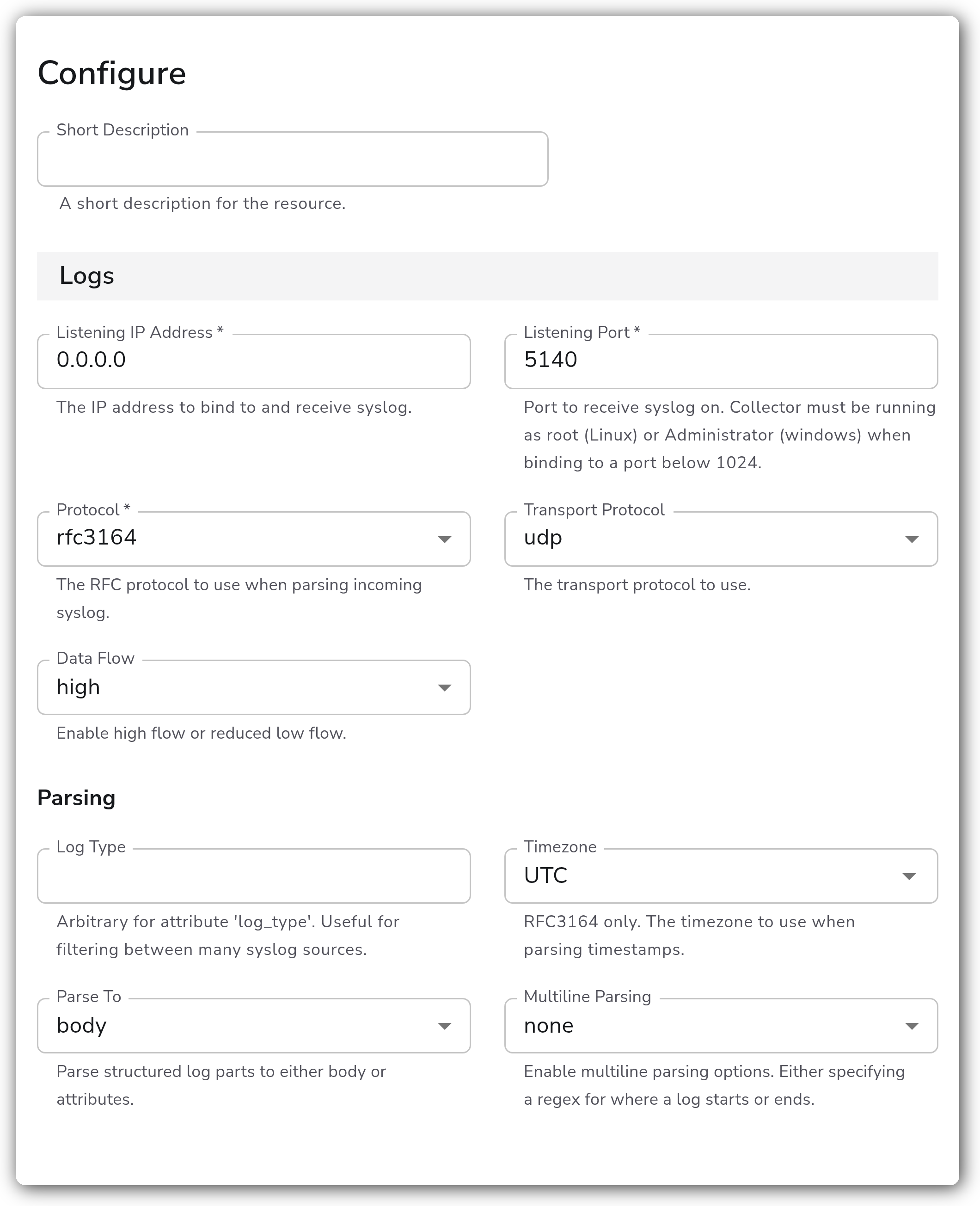
<figure><img src="/files/suNaihFwIfXkGG2WDwWP" alt="Bindplane docs - Syslog - image 1"><figcaption></figcaption></figure>

**Logs**

| Parameter               | Type                                             | Required | Default   | Description                                                                                                                                         |
| ----------------------- | ------------------------------------------------ | -------- | --------- | --------------------------------------------------------------------------------------------------------------------------------------------------- |
| Listening IP Address    | String                                           | Yes      | 0.0.0.0   | The IP address to bind to and receive syslog.                                                                                                       |
| Listening Port          | Integer                                          | Yes      | 5140      | Port to receive syslog on. Collector must be running as root (Linux) or Administrator (Windows) when binding to a port below 1024.                  |
| Protocol                | Enum: rfc3164, rfc5424, none                     | Yes      | rfc3164   | The RFC protocol to use when parsing incoming syslog. Set to `none` to leave messages unparsed by any RFC.                                          |
| Transport Protocol      | Enum: udp, tcp                                   | No       | udp       | The transport protocol to use.                                                                                                                      |
| Data Flow               | Enum: high, low                                  | No       | high      | Enable high flow or reduced low flow. Low flow filters out lower-priority records and retains a reduced set of fields.                              |
| Log Type                | String                                           | No       | *(empty)* | Arbitrary value for the `log_type` attribute. Useful for filtering between many syslog sources.                                                     |
| Timezone                | Timezone                                         | No       | UTC       | RFC 3164 only. The timezone to use when parsing timestamps.                                                                                         |
| Parse To                | Enum: body, attributes                           | No       | body      | Parse structured log parts to either the body or attributes.                                                                                        |
| Multiline Parsing       | Enum: none, specify line start, specify line end | No       | none      | Enable multiline parsing by specifying a regex for where a log starts or ends.                                                                      |
| Multiline Start Pattern | String                                           | Yes      | *(empty)* | Regex pattern that matches the beginning of a log entry, for handling multiline logs. Applies when Multiline Parsing is `specify line start`.       |
| Multiline End Pattern   | String                                           | Yes      | *(empty)* | Regex pattern that matches the end of a log entry, for terminating parsing of multiline logs. Applies when Multiline Parsing is `specify line end`. |
| Add Attributes          | Boolean                                          | No       | false     | Adds `net.*` attributes according to OpenTelemetry semantic conventions.                                                                            |

**Advanced**

| Parameter                              | Type                     | Required | Default   | Description                                                                                                                                                                                                                                                                                         |
| -------------------------------------- | ------------------------ | -------- | --------- | --------------------------------------------------------------------------------------------------------------------------------------------------------------------------------------------------------------------------------------------------------------------------------------------------- |
| Enable Octet Counting                  | Boolean                  | No       | false     | Whether to enable RFC 6587 octet counting on syslog framing, allowing transmission of all characters inside a syslog message. Applies when Transport Protocol is `tcp`, Protocol is `rfc5424`, and Non-Transparent Framing Trailer is disabled. Incompatible with non-transparent framing trailers. |
| Enable Non-Transparent Framing Trailer | Boolean                  | No       | false     | Whether to parse using a trailer character that terminates each syslog message. Applies when Transport Protocol is `tcp`, Protocol is `rfc5424`, and Octet Counting is disabled. Incompatible with octet counting.                                                                                  |
| Non-Transparent Framing Trailer        | Enum: LF, NUL            | No       | LF        | The framing trailer when using RFC 6587 non-transparent framing. Applies when Transport Protocol is `tcp` and Non-Transparent Framing Trailer is enabled.                                                                                                                                           |
| Preserve Leading Whitespace            | Boolean                  | No       | false     | Whether to preserve leading whitespace on the raw log line before parsing. May break parsing when enabled.                                                                                                                                                                                          |
| Preserve Trailing Whitespace           | Boolean                  | No       | false     | Whether to preserve trailing whitespace on the raw log line before parsing.                                                                                                                                                                                                                         |
| Enable TLS                             | Boolean                  | No       | false     | Whether to use TLS. Applies when Transport Protocol is `tcp`.                                                                                                                                                                                                                                       |
| TLS Certificate File                   | String                   | Yes      | *(empty)* | Path to the x509 PEM certificate. Applies when Enable TLS is true.                                                                                                                                                                                                                                  |
| TLS Private Key File                   | String                   | Yes      | *(empty)* | Path to the x509 PEM private key. Applies when Enable TLS is true.                                                                                                                                                                                                                                  |
| TLS Certificate Authority File         | String                   | No       | *(empty)* | When set, enforces mutual TLS authentication and verifies client certificates. Applies when Enable TLS is true.                                                                                                                                                                                     |
| Minimum TLS Version                    | Enum: 1.3, 1.2, 1.1, 1.0 | No       | 1.2       | The minimum TLS version to support. 1.0 and 1.1 should not be considered secure. Applies when Enable TLS is true.                                                                                                                                                                                   |
| Max Log Size                           | String                   | No       | 1MiB      | The maximum size of a log entry to read. Larger entries are truncated. Protects against reading large amounts of data into memory. Applies when Transport Protocol is `tcp`.                                                                                                                        |
| Async Readers                          | Integer                  | No       | 1         | Determines how many workers read from the UDP port and push to the buffer. Applies when Transport Protocol is `udp`.                                                                                                                                                                                |
| Async Processors                       | Integer                  | No       | 3         | Determines how many workers read from the buffer and process logs before sending downstream. Applies when Transport Protocol is `udp`.                                                                                                                                                              |
| Async Max Queue Length                 | Integer                  | No       | 100       | Length of the buffer used by async reader workers. When the buffer is full, reader workers block until it has room. Applies when Transport Protocol is `udp`.                                                                                                                                       |

### Examples

#### Receive RFC 5424 syslog over TCP with mutual TLS

Listen on TCP port 6514 for RFC 5424 messages, parse the structured fields into attributes, and require client certificates for mutual TLS.

```yaml
apiVersion: bindplane.observiq.com/v1
kind: Source
metadata:
  name: syslog
spec:
  type: syslog
  parameters:
    - name: listen_ip
      value: "0.0.0.0"
    - name: listen_port
      value: 6514
    - name: protocol
      value: rfc5424
    - name: connection_type
      value: tcp
    - name: parse_to
      value: attributes
    - name: enable_mutual_tls
      value: true
    - name: cert_file
      value: /opt/tls/server.crt
    - name: key_file
      value: /opt/tls/server.key
    - name: ca_file
      value: /opt/tls/ca.crt
    - name: tls_min_version
      value: "1.2"
```

### Configuration Tips

* UDP (the default) is the simplest transport and is what most appliances send by default, but it offers no delivery guarantee and can drop messages under load. Use TCP when you need reliable delivery or when you require TLS, since TLS, octet counting, non-transparent framing trailers, and `max_log_size` apply only to TCP.
* Match the Protocol setting to what the sender emits. RFC 3164 is the older BSD format (and the only one that uses the Timezone setting). RFC 5424 is the structured-data format and is required for octet counting and framing-trailer options.
* Set Data Flow to `low` to reduce volume: it filters out lower-priority records and retains only a reduced set of fields (hostname, appname, msg\_id, structured\_data, version). Leave it at `high` to keep the full parsed message.
* For high-volume UDP sources, the async tuning parameters control throughput. Increase Async Processors first when the collector is under load, then increase Async Max Queue Length if you expect short bursts of elevated volume. Async Readers should generally stay at 1 unless directed by Bindplane support.

### Troubleshooting

#### No logs arriving

Symptoms: the source is configured but no syslog records reach the pipeline.

Solutions:

1. Confirm the sending device or application is forwarding syslog to the collector's IP address and the configured listen port.
2. Verify the listen port is open in the host firewall and any cloud security groups, network policies, or load balancers between the sender and the collector.
3. Confirm the Transport Protocol matches the sender (a TCP sender will not reach a UDP listener, and the reverse).

#### Permission denied binding the port

Symptoms: the collector fails to start or the source errors when binding the listen port.

Solutions:

1. Ports below 1024 require running the collector as root on Linux or as Administrator on Windows.
2. Use the default port 5140, or another port above 1024, to avoid needing elevated privileges.

#### TLS handshake errors

Symptoms: TCP connections from senders fail during the TLS handshake.

Solutions:

1. Confirm the certificate, private key, and (for mutual TLS) certificate authority file paths are correct and readable by the collector.
2. Ensure the sender's TLS version meets the configured Minimum TLS Version, and that the client certificate is signed by the configured CA when a CA file is set.

### Standalone Source

```yaml
apiVersion: bindplane.observiq.com/v1
kind: Source
metadata:
  name: syslog
spec:
  type: syslog
  parameters:
    - name: listen_ip
      value: "0.0.0.0"
    - name: listen_port
      value: 5140
    - name: protocol
      value: rfc3164
    - name: connection_type
      value: udp
    - name: data_flow
      value: high
    - name: timezone
      value: UTC
    - name: parse_to
      value: body
```

### Kubernetes and OpenShift

When using this source with Kubernetes or OpenShift, you must create a custom Service resource to route traffic to the collector. See the Kubernetes [Service](/deployment/kubernetes/collector/custom-service.md) for more information.

### Related Resources

* [Syslog Receiver — OpenTelemetry Collector Contrib](https://github.com/open-telemetry/opentelemetry-collector-contrib/tree/main/receiver/syslogreceiver)
* [RFC 5424 — The Syslog Protocol](https://datatracker.ietf.org/doc/html/rfc5424)
* [RFC 6587 — Transmission of Syslog Messages over TCP](https://datatracker.ietf.org/doc/html/rfc6587)


---

# Agent Instructions
This documentation is published with GitBook. GitBook is the documentation platform designed so that both humans and AI agents can read, navigate, and reason over technical content effectively. Learn more at gitbook.com.

## Querying This Documentation
If you need additional information that is not directly available in this page, you can query the documentation dynamically by asking a question.

Perform an HTTP GET request on the current page URL with the `ask` query parameter, and the optional `goal` query parameter:

```
GET https://docs.bindplane.com/integrations/sources/syslog.md?ask=<question>&goal=<endgoal>
```

`ask` is the immediate question: it should be specific, self-contained, and written in natural language.
`goal` is optional and describes the broader end goal you are ultimately trying to accomplish on behalf of the user. GitBook uses it to tailor the answer towards what is most useful for that goal.

The response will contain a direct answer to the question and relevant excerpts and sources from the documentation.

Use this mechanism when the answer is not explicitly present in the current page, you need clarification or additional context, or you want to retrieve related documentation sections.