> For the complete documentation index, see [llms.txt](https://docs.bindplane.com/llms.txt). Markdown versions of documentation pages are available by appending `.md` to page URLs; this page is available as [Markdown](https://docs.bindplane.com/integrations/sources/logstash.md).
# Logstash
The Logstash source receives logs forwarded from [Logstash](https://www.elastic.co/logstash) over TCP. Bindplane runs a TCP listener that accepts newline-delimited JSON events from a Logstash `tcp` output, parses the standard Logstash fields (`@timestamp`, `host.name`, `log.file.path`, `message`), and maps them onto the OpenTelemetry log record.
### Supported Telemetry Types
| Platform | Metrics | Logs | Traces |
| -------- | ------- | ---- | ------ |
| Linux | | ✓ | |
| Windows | | ✓ | |
| macOS | | ✓ | |
### Prerequisites
* A running Logstash instance with a [`tcp` output](https://www.elastic.co/guide/en/logstash/current/plugins-outputs-tcp.html) configured to send JSON-encoded events to the collector.
* The collector reachable from Logstash on the configured TCP port.
* When TLS is enabled, a TLS certificate and private key available on the collector host.
### Configuration
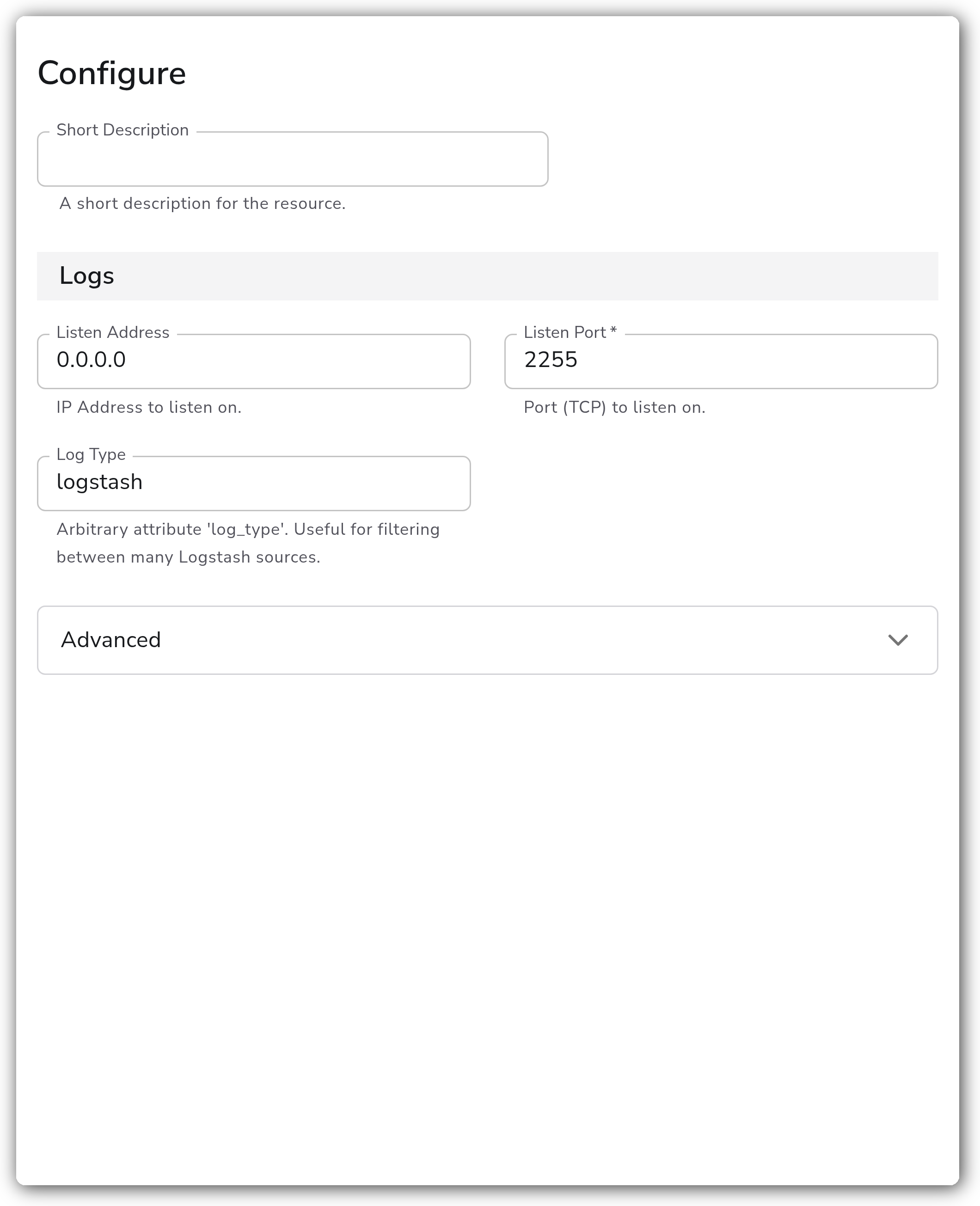
#### Logs
| Parameter | Type | Default | Description |
| -------------- | ------- | ---------- | --------------------------------------------------------------------------------------- |
| Listen Address | String | `0.0.0.0` | IP address to listen on. |
| Listen Port | Integer | `2255` | TCP port to listen on. Required. |
| Log Type | String | `logstash` | Value for the `log_type` attribute. Useful for filtering between many Logstash sources. |
#### Advanced (TLS)
| Parameter | Type | Default | Description |
| -------------------- | ------- | ------- | --------------------------------------------------------------------------------------------------------------------------------------------------- |
| Enable TLS | Boolean | `false` | Whether or not to use TLS. |
| TLS Certificate File | String | | Path to the TLS certificate to use for TLS-required connections. Applies when TLS is enabled. |
| TLS Private Key File | String | | Path to the TLS private key to use for TLS-required connections. Applies when TLS is enabled. |
| Minimum TLS Version | Enum | `1.2` | Minimum TLS version to support. Valid values: `1.3`, `1.2`, `1.1`, `1.0`. 1.0 and 1.1 should not be considered secure. Applies when TLS is enabled. |
### Example Configuration
#### Standalone Source
```yaml
apiVersion: bindplane.observiq.com/v1
kind: Source
metadata:
id: logstash
name: logstash
spec:
type: logstash
parameters:
- name: listen_ip
value: '0.0.0.0'
- name: listen_port
value: '2255'
- name: log_type
value: 'logstash'
- name: enable_tls
value: 'false'
```
With TLS enabled:
```yaml
apiVersion: bindplane.observiq.com/v1
kind: Source
metadata:
id: logstash
name: logstash
spec:
type: logstash
parameters:
- name: listen_ip
value: '0.0.0.0'
- name: listen_port
value: '2255'
- name: log_type
value: 'logstash'
- name: enable_tls
value: 'true'
- name: tls_certificate_path
value: '/opt/observiq-otel-collector/logstash.crt'
- name: tls_private_key_path
value: '/opt/observiq-otel-collector/logstash.key'
- name: tls_min_version
value: '1.2'
```
### Configuring Logstash to forward to the collector
The Logstash source expects newline-delimited JSON events. On the Logstash side, configure a [`tcp` output](https://www.elastic.co/guide/en/logstash/current/plugins-outputs-tcp.html) with the `json_lines` codec pointed at the collector's host and listen port:
```ruby
output {
tcp {
host => ""
port => 2255
codec => json_lines
}
}
```
* `` is the address of the collector running the Logstash source.
* `port` must match the `listen_port` configured on the source (`2255` by default).
* The `json_lines` codec is required so each event is delivered as a single JSON object per line.
The source parses the standard Logstash fields automatically: `@timestamp` is promoted to the log record timestamp, `host.name` becomes a resource attribute, `log.file.path` becomes a log record attribute, and the `@timestamp`, `event.original`, and `@version` fields are removed after parsing.
### Configuration Tips
#### Distinguishing multiple Logstash sources
* Set `log_type` to a distinct value per source so downstream pipelines can filter events by their origin. The value is written to the `log_type` attribute on every record.
#### Enabling TLS
* Set `enable_tls` to `true` and provide `tls_certificate_path` and `tls_private_key_path` on the collector host.
* Configure a matching [`ssl_enable`](https://www.elastic.co/guide/en/logstash/current/plugins-outputs-tcp.html) block on the Logstash `tcp` output so the two ends agree on TLS.
* Leave `tls_min_version` at `1.2` or higher; 1.0 and 1.1 are not considered secure.
### Troubleshooting
**Symptom:** No logs arrive from Logstash. **Solution:** Confirm the Logstash `tcp` output `host` and `port` match the collector address and the source `listen_port` (`2255` by default), and that the collector is reachable from Logstash on that port. Verify the output uses the `json_lines` codec.
**Symptom:** Logs arrive but the message body is a single unparsed JSON string instead of structured fields. **Solution:** The source parses JSON events. Make sure the Logstash `tcp` output uses the `json_lines` codec so each event is sent as one JSON object per line. Plain-text or `line` codecs will not parse correctly.
**Symptom:** The log record timestamp does not match event time. **Solution:** Ensure the events include an `@timestamp` field in the format `%Y-%m-%dT%H:%M:%S.%fZ` (the Logstash default). When `@timestamp` is absent, the receiver falls back to ingestion time.
### Related Resources
* [Logstash documentation](https://www.elastic.co/guide/en/logstash/current/introduction.html)
* [Logstash TCP output plugin](https://www.elastic.co/guide/en/logstash/current/plugins-outputs-tcp.html)
---
# Agent Instructions
This documentation is published with GitBook. GitBook is the documentation platform designed so that both humans and AI agents can read, navigate, and reason over technical content effectively. Learn more at gitbook.com.
## Querying This Documentation
If you need additional information that is not directly available in this page, you can query the documentation by asking a question.
Perform an HTTP GET request on the following URL with the `ask` and `goal` query parameters:
```
GET https://docs.bindplane.com/integrations/sources/logstash.md?ask=&goal=
```
`ask` is the immediate question: it should be specific, self-contained, and written in natural language.
`goal` is what the user is ultimately trying to achieve, the reason they need the answer. Sharing it helps GitBook give you a better, more relevant answer. A goal is most helpful when it describes the outcome the user wants rather than restating the question. For example, with `ask=how do I create an API token`, a goal like `automate deployments from our CI pipeline` lets GitBook tailor the answer to that use case.
The response will contain a direct answer to the question and relevant excerpts and sources from the documentation.
Use this mechanism when the answer is not explicitly present in the current page, you need clarification or additional context, or you want to retrieve related documentation sections.