> For the complete documentation index, see [llms.txt](https://docs.bindplane.com/llms.txt). Markdown versions of documentation pages are available by appending `.md` to page URLs; this page is available as [Markdown](https://docs.bindplane.com/integrations/sources/pgbouncer.md).
# PgBouncer
The PgBouncer source collects logs from a PgBouncer connection pooler. It tails one or more PgBouncer log files from disk and, optionally, parses each line into structured fields. This source collects logs only; it does not scrape metrics.
### Supported Telemetry Types
| Platform | Metrics | Logs | Traces |
| -------- | ------- | ---- | ------ |
| Linux | | ✓ | |
| Windows | | ✓ | |
| macOS | | ✓ | |
### Prerequisites
* PgBouncer configured to write to a log file. Set `logfile` in `pgbouncer.ini` to the path the collector will read. See the [PgBouncer configuration reference](https://www.pgbouncer.org/config.html) for the `logfile` and related log settings.
* The collector must run on the same host as PgBouncer (or have read access to the PgBouncer log file by another means).
* The collector process must have read permission on the configured log file path(s).
If PgBouncer is configured to send logs to syslog rather than a file, use a syslog-based source instead; this source reads from log files on disk.
### Configuration
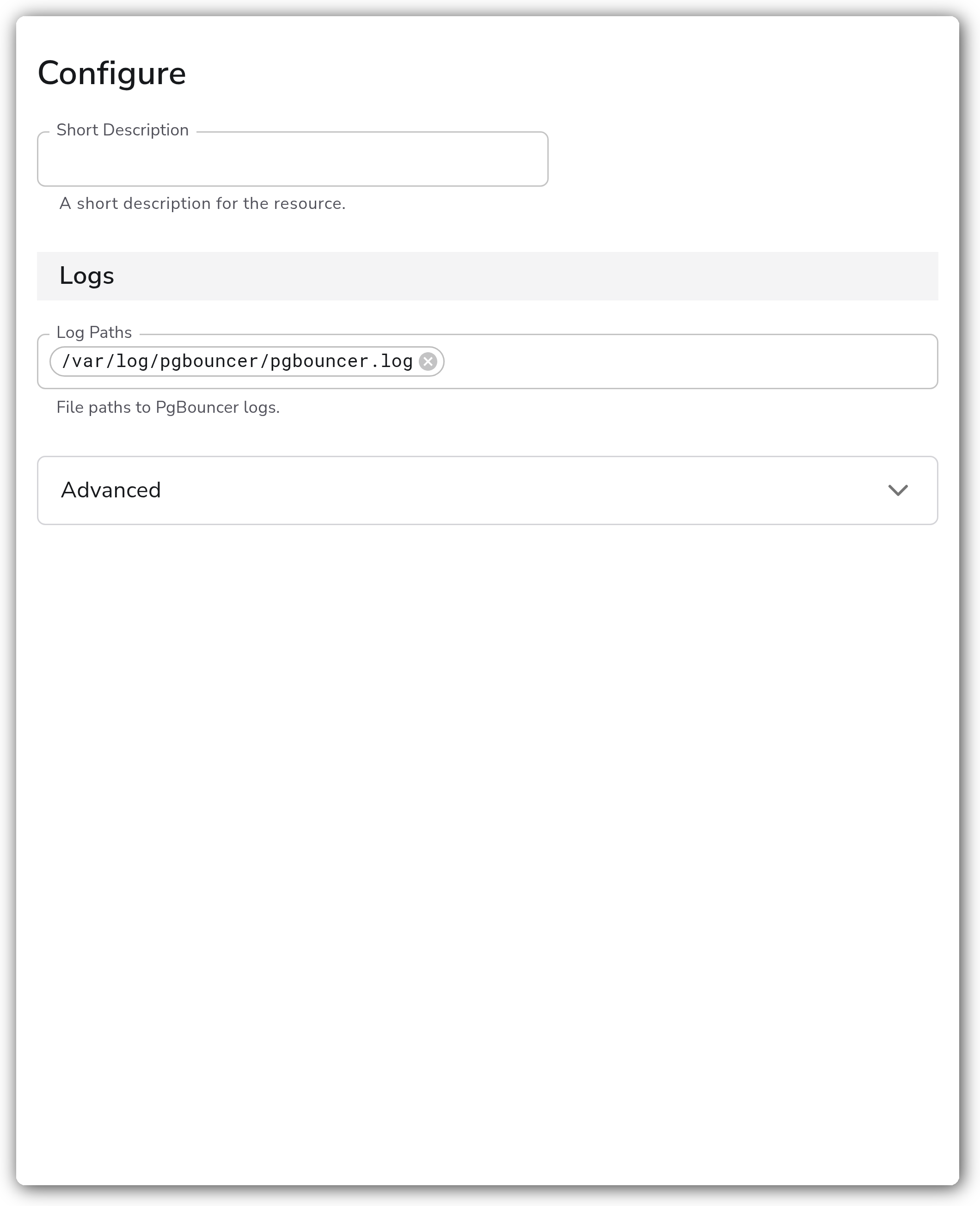
**Logs**
| Parameter | Type | Required | Default | Description |
| --------- | ------- | -------- | ---------------------------------- | ----------------------------------------------------- |
| Log Paths | Strings | No | `/var/log/pgbouncer/pgbouncer.log` | File paths to PgBouncer logs. Accepts multiple paths. |
**Advanced**
| Parameter | Type | Required | Default | Description |
| --------- | -------------------- | -------- | ------- | --------------------------------------------------------- |
| Start At | Enum: beginning, end | No | `end` | Start reading logs from `beginning` or `end` of the file. |
| Parse | Boolean | No | `true` | Parses the log fields into structured data. |
### Examples
#### Collect PgBouncer logs from a non-default path
A PgBouncer instance writes its log to `/opt/pgbouncer/logs/pgbouncer.log`. This configuration reads that file, starts at the end so only new lines are collected, and parses each line into structured fields.
```yaml
- name: file_path
value:
- /opt/pgbouncer/logs/pgbouncer.log
- name: start_at
value: end
- name: parse
value: true
```
### Configuration Tips
* Set **Start At** to `beginning` the first time you want to backfill an existing log file; leave it at `end` to collect only new entries going forward.
* Disable **Parse** if you want to forward the raw log line unmodified, for example when a downstream processor handles parsing.
* Provide multiple paths under **Log Paths** to collect from more than one PgBouncer instance on the same host.
### Troubleshooting
#### No logs are collected
Symptoms: the source is running but no log records arrive.
Solutions:
1. Confirm PgBouncer is configured with a `logfile` and is actively writing to it.
2. Verify the path in **Log Paths** matches the actual log file location and that the collector process has read permission on it.
3. If the file already existed before the source started and you expect historical lines, set **Start At** to `beginning`.
#### Log lines arrive unparsed
Symptoms: records appear but fields are not broken out into structured data.
Solutions:
1. Confirm **Parse** is enabled.
2. Verify the log lines follow the standard PgBouncer log format; non-standard or custom formats may not parse cleanly.
### Standalone Source
```yaml
apiVersion: bindplane.observiq.com/v1
kind: Source
metadata:
name: pgbouncer
spec:
type: pgbouncer
parameters:
- name: file_path
value:
- /var/log/pgbouncer/pgbouncer.log
- name: start_at
value: end
- name: parse
value: true
```
### Related Resources
* [PgBouncer configuration reference (log settings)](https://www.pgbouncer.org/config.html)
* [filelogreceiver — OpenTelemetry Collector Contrib](https://github.com/open-telemetry/opentelemetry-collector-contrib/tree/main/receiver/filelogreceiver)
---
# Agent Instructions
This documentation is published with GitBook. GitBook is the documentation platform designed so that both humans and AI agents can read, navigate, and reason over technical content effectively. Learn more at gitbook.com.
## Querying This Documentation
If you need additional information that is not directly available in this page, you can query the documentation by asking a question.
Perform an HTTP GET request on the following URL with the `ask` and `goal` query parameters:
```
GET https://docs.bindplane.com/integrations/sources/pgbouncer.md?ask=&goal=
```
`ask` is the immediate question: it should be specific, self-contained, and written in natural language.
`goal` is what the user is ultimately trying to achieve, the reason they need the answer. Sharing it helps GitBook give you a better, more relevant answer. A goal is most helpful when it describes the outcome the user wants rather than restating the question. For example, with `ask=how do I create an API token`, a goal like `automate deployments from our CI pipeline` lets GitBook tailor the answer to that use case.
The response will contain a direct answer to the question and relevant excerpts and sources from the documentation.
Use this mechanism when the answer is not explicitly present in the current page, you need clarification or additional context, or you want to retrieve related documentation sections.