> For the complete documentation index, see [llms.txt](https://docs.bindplane.com/llms.txt). Markdown versions of documentation pages are available by appending `.md` to page URLs; this page is available as [Markdown](https://docs.bindplane.com/integrations/processors/parse-severity.md).
# Parse Severity
Maps the severity values found in your logs onto standard levels and sets both `severity_text` and `severity_number` accordingly. You point it at the field holding the severity value and list which source values map to each standard level (TRACE, DEBUG, INFO, WARN, ERROR, FATAL), so logs from different sources end up with a consistent severity.
### Supported Telemetry Types
| Platform | Metrics | Logs | Traces |
| ----------------------- | ------- | ---- | ------ |
| Linux | | ✓ | |
| Windows | | ✓ | |
| macOS | | ✓ | |
| AIX | | ✓ | |
| Kubernetes Node | | ✓ | |
| Kubernetes Cluster | | ✓ | |
| Kubernetes Gateway | | ✓ | |
| OpenShift Node | | ✓ | |
| OpenShift Cluster | | ✓ | |
| OpenShift Gateway | | ✓ | |
| Google SecOps Pipelines | | ✓ | |
This processor operates on logs only. It reads the configured severity field and sets the record's `severity_text` and `severity_number`.
### Configuration
#### Basic Configuration
**Selection**
| Parameter | Type | Required | Default | Description |
| -------------- | ------------------------------- | -------- | --------- | ---------------------------------------------------------------------------------------------------------------------- |
| Condition | OTTL Condition | No | *(empty)* | An OTTL condition that must evaluate to true for the processor to apply. Empty applies to all logs. |
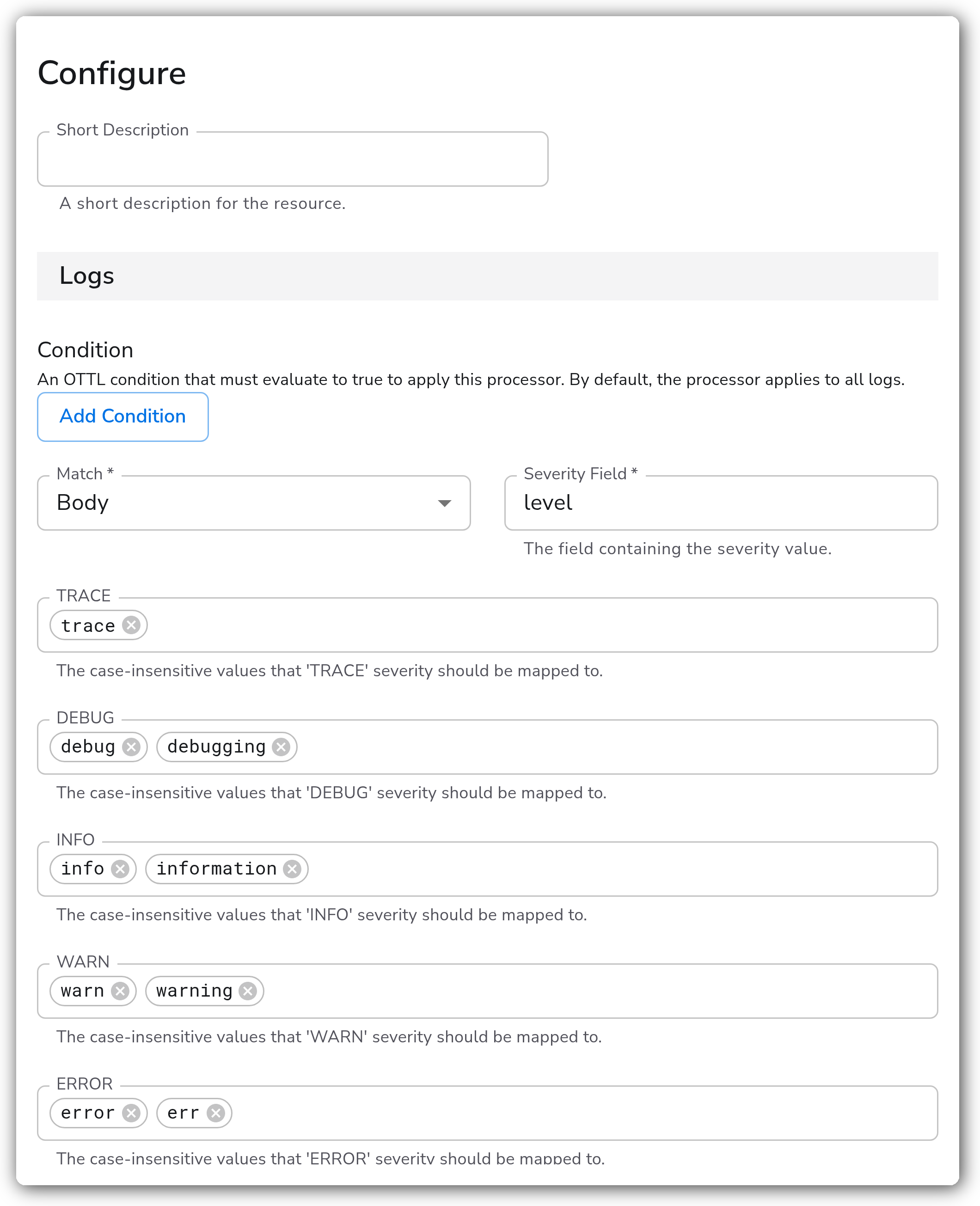
| Match | Enum: Resource, Attribute, Body | Yes | Body | Where the severity value is read from: the log body, a resource attribute, or a log attribute. |
| Severity Field | OTTL Field | Yes | — | The field containing the severity value. Its context (body, attribute, or resource) follows the Match selection above. |
**Severity mappings**
Each level takes a list of case-insensitive values that should be mapped to that standard level. A record whose severity field matches one of these values has its `severity_text` set to the level name and its `severity_number` set to the matching standard number.
| Parameter | Type | Required | Default | Description |
| --------- | ------- | -------- | ------- | -------------------------------------------------------------------- |
| TRACE | Strings | No | `trace` | The case-insensitive values that should be mapped to TRACE severity. |
| DEBUG | Strings | No | `debug` | The case-insensitive values that should be mapped to DEBUG severity. |
| INFO | Strings | No | `info` | The case-insensitive values that should be mapped to INFO severity. |
| WARN | Strings | No | `warn` | The case-insensitive values that should be mapped to WARN severity. |
| ERROR | Strings | No | `error` | The case-insensitive values that should be mapped to ERROR severity. |
| FATAL | Strings | No | `fatal` | The case-insensitive values that should be mapped to FATAL severity. |
### Examples
#### Normalize a non-standard `level` field
A source emits logs whose severity lives in a `level` body field and uses abbreviations and long-form words that don't match the standard levels:
```json
{
"message": "An error occurred during processing",
"level": "err"
}
```
Configure the processor to read `level` from the body and add the source-specific values to each level's mapping list:
* Match: `Body`
* Severity Field: `level`
* ERROR: `error`, `err`
* WARN: `warn`, `warning`
* INFO: `info`, `information`
* DEBUG: `debug`, `debugging`
* FATAL: `fatal`, `critical`
When the record above is processed, `err` matches the ERROR list, so the record's severity is normalized:
```
severity_text: error
severity_number: 17
```
The original `level` field is left in place. The processor sets the record's standard severity fields rather than rewriting the source field.
### Configuration Tips
* Beyond plain string matching, a mapping value can be an HTTP status code range written as `1xx`, `2xx`, `3xx`, `4xx`, or `5xx`. For example, putting `5xx` in the ERROR list maps any 5xx status to ERROR.
* A mapping value can also be a numeric range written as `8-12`. Any number in that range (such as 9) maps to the level the range is assigned to.
* Matching is case-insensitive, so `Error`, `ERROR`, and `error` are treated the same.
### Troubleshooting
#### Severity is not being set
Symptoms: records pass through with their original `severity_text` and `severity_number` unchanged.
Solutions:
1. Confirm Match points at the right location (Body, Attribute, or Resource) and that Severity Field names the actual field holding the value.
2. Verify the source value appears in one of the mapping lists. The defaults only cover the literal level names (`trace`, `debug`, `info`, `warn`, `error`, `fatal`); add your source's values to the appropriate list.
3. If a Condition is set, confirm it evaluates true for the records you expect to change.
### Standalone Processor
```yaml
apiVersion: bindplane.observiq.com/v1
kind: Processor
metadata:
name: parse-severity
spec:
type: parse_severity_v2
parameters:
- name: log_condition
value: ""
- name: match
value: Body
- name: body_severity_field
value: level
- name: trace_mappings
value:
- trace
- name: debug_mappings
value:
- debug
- debugging
- name: info_mappings
value:
- info
- information
- name: warn_mappings
value:
- warn
- warning
- name: error_mappings
value:
- error
- err
- name: fatal_mappings
value:
- fatal
- critical
```
### Related Resources
* [OTTL Log Context](https://github.com/open-telemetry/opentelemetry-collector-contrib/blob/main/pkg/ottl/contexts/ottllog/README.md)
* [OTTL Booleans](https://github.com/open-telemetry/opentelemetry-collector-contrib/blob/main/pkg/ottl/LANGUAGE.md#booleans)
### Bindplane Resources
* [Parse JSON](/integrations/processors/parse-json.md)
* [Parse Timestamp](https://github.com/observIQ/bindplane-docs/blob/main/docs/integrations/processors/parse-timestamp.md)
* [Parse Key Value](/integrations/processors/parse-key-value.md)
---
# Agent Instructions
This documentation is published with GitBook. GitBook is the documentation platform designed so that both humans and AI agents can read, navigate, and reason over technical content effectively. Learn more at gitbook.com.
## Querying This Documentation
If you need additional information that is not directly available in this page, you can query the documentation by asking a question.
Perform an HTTP GET request on the following URL with the `ask` and `goal` query parameters:
```
GET https://docs.bindplane.com/integrations/processors/parse-severity.md?ask=&goal=
```
`ask` is the immediate question: it should be specific, self-contained, and written in natural language.
`goal` is what the user is ultimately trying to achieve, the reason they need the answer. Sharing it helps GitBook give you a better, more relevant answer. A goal is most helpful when it describes the outcome the user wants rather than restating the question. For example, with `ask=how do I create an API token`, a goal like `automate deployments from our CI pipeline` lets GitBook tailor the answer to that use case.
The response will contain a direct answer to the question and relevant excerpts and sources from the documentation.
Use this mechanism when the answer is not explicitly present in the current page, you need clarification or additional context, or you want to retrieve related documentation sections.